


Ask a university leader about AI and you’ll likely hear “We’re all in.” In EDUCAUSE’s most recent AI Landscape Study, 57% of institutions called AI a strategic priority, but only 22% had an institution-wide AI strategy. More than half (55%) said the work was happening “in pockets” across campus.
Students aren’t waiting for the plan. 92% of undergraduates now use AI tools, up from 66% a year earlier, and 88% have used generative AI on assessed work. Only 36% say their institution has helped them build AI skills (HEPI 2025). Faculty are behind them: 61% have used AI in teaching, but most of that use is minimal, and only 17% rate their AI literacy as advanced. The top two barriers are a lack of guidelines and a lack of training (Digital Education Council).
The gap is widest where research universities should be strongest. University computing clusters are growing about 18% a year, compared with about 43% for national labs and about 78% for industry (2025 survey of 50+ U.S. research institutions covered by Forbes).
So what does “all in” mean? A policy page? A ChatGPT Edu or Gemini license? A new AI degree? A GPU cluster in the basement of the engineering building?
Our benchmark scored 177 R1 leading research universities on five key pillars of AI adoption: strategy, access, curriculum, faculty readiness, and compute. The key insight? AI adoption is driven by leadership decisions and institutional will rather than endowment size or research funding. Here’s what the data shows.
What Makes Up The Benchmark?
We evaluated 177 Carnegie-classified R1 doctoral universities with very high research activity, using data from the U.S. National Science Foundation (NSF) FY2024 research spending rankings. R1 represents the highest level of university research activity in the United States.
Then we scored each school 0 to 3 in five categories (where 0 = No documented progress/Below Average, 1 = Emerging/In Pockets, 2 = Established/Average, and 3 = Advanced/Above Average):
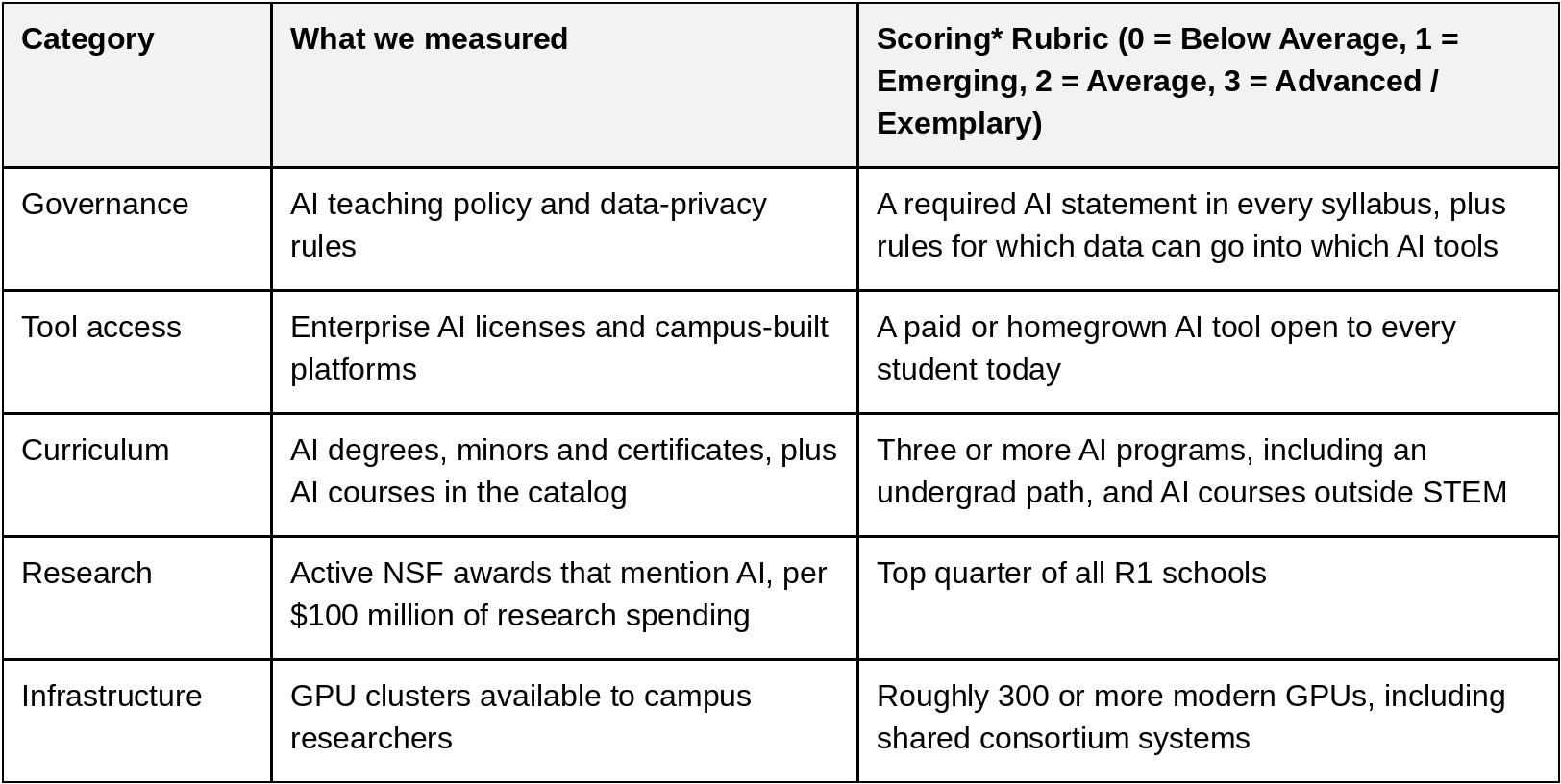
*Scores are based on publicly available data and course listings, and have been adjusted for missing information that was either log-in protected or part of a statewide system.
What We Found
Across the 177 R1 institutions we evaluated, the average composite score was 69 out of 100 (representing baseline average adoption). Only UT Austin scored a perfect 100. Here are our six takeaways.
1. Every school has an AI policy. Almost none require one in the classroom.
While 72% of the 177 R1 universities publish data-privacy rules for AI, only 15 institutions (roughly 8%) mandate an AI statement in every course syllabus. Everywhere else, syllabus guidance remains optional or fragmented.
2. A third of schools give every student a secure AI tool. The rest are still deciding.
Only 34% of the 177 R1 universities we reviewed provide a paid or homegrown enterprise AI platform for all students. Institutions offering full access average a composite score of 75 at the highest end of our ranking, compared to 51 for those offering only basic bundled tools or no enterprise access, sitting at the lower end. Across the top 100 R1s, half (50) offer full access, whereas only 14% of the remaining 77 institutions do so.
3. Curriculum is the strongest category, and AI has left the computer science building.
Curriculum ranked Average to Advanced across the benchmark scale (2.5 out of 3), making it the highest-performing category. Sixty-eight percent of the R1 universities we evaluated now offer an undergraduate AI degree path, minor, or certificate.
Our study of 93 course catalogs for courses that mention "artificial intelligence" found that on average, universities offer 20 AI courses, with Stanford leading with 165 courses. Notably, we found AI isn't just a computer science topic anymore. Approximately half of those courses sit outside STEM – in business, law, philosophy, journalism and education degree and certificate programs.
4. Infrastructure is a story of haves and have-nots.
Only 16% of the 177 R1 universities evaluated possess roughly 300 or more modern GPUs for campus-wide research, with 42% scoring a 1 or below on compute infrastructure.
5. Bigger research budgets don't buy better adoption.
The top spending research universities average the same AI adoption scores (69) as the rest of the top 100 universities, demonstrating that research funding alone does not give top universities a significant adoption advantage.
While research funding can buy more GPUs, it doesn't write a syllabus policy or license a tool for students. Those are leadership decisions, not budget decisions.
6. Conference matters more than you'd think.
Grouping schools that compare themselves by athletic conference, revealed SEC schools are leading.
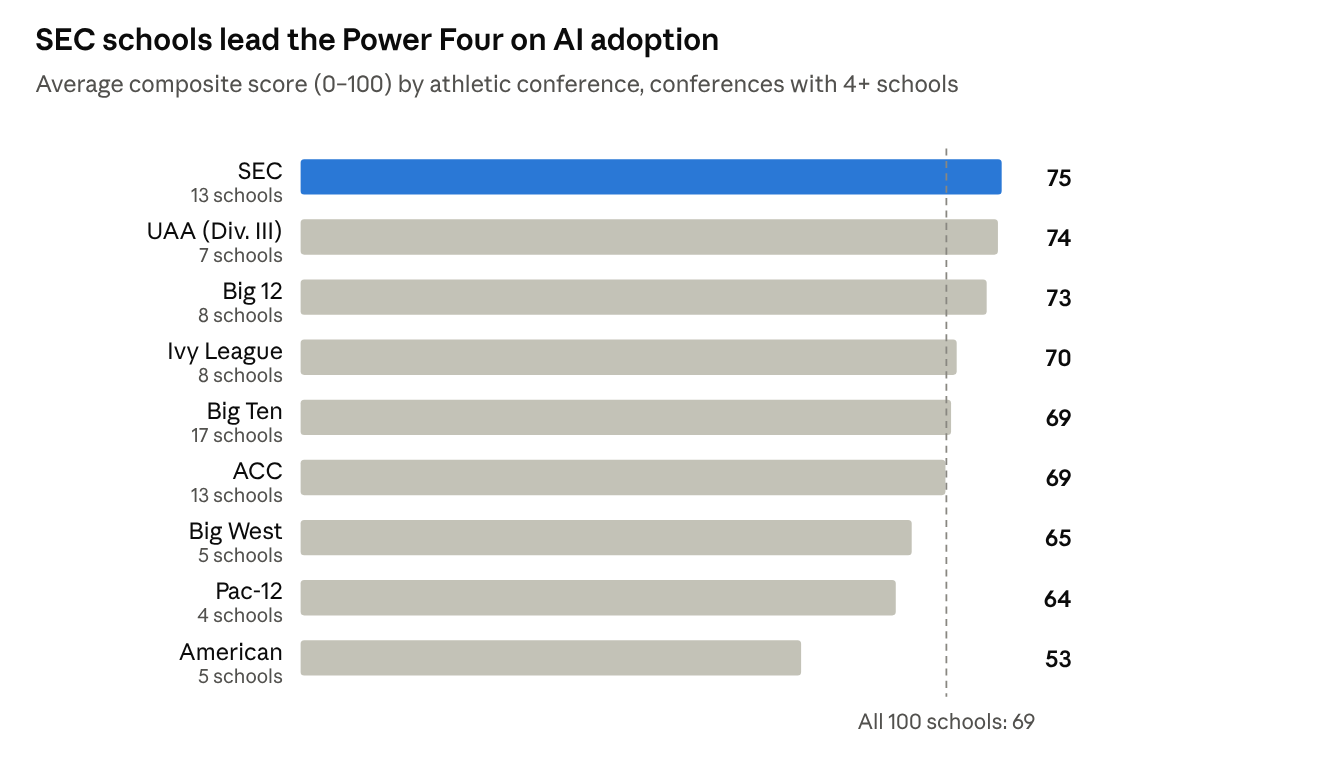
R1 AI Adoption Benchmark, 100 schools, researched Oct 2026 · conference = primary athletic conference 2026-27
The SEC leads the Power Four (75), ahead of the Big 12 (73) and Ivy League Universities (70), which all outperformed the average composite score, where the Big Ten and ACC schools fell. The American Athletic Conference trails (53), falling below average because none of its five schools provides every student with an enterprise AI tool.
The good news is, with only a 22 point difference overall, the gap is real but can be closed.
Key Findings and 2027 Action Items
1. Close the biggest gap: put a real and sanctioned AI tool in every student’s hands
- 34% of R1s provide a paid or homegrown AI platform (e.g., ChatGPT Edu, Claude, Gemini, or custom-built).
- 29% offer only basic bundled tools (free Copilot/Gemini) or nothing documented.
- Impact on scores: Schools with the highest composite scores (75) provide full student access, compared to those with the lowest composite scores (51).
- Access gap: half of the top 100 offer full access, compared to just 14% of the remaining 77 schools.
- 2027 Focus: Shift from basic tool availability to a supported, campus-wide platform with built-in training.
2. Data rules are common, rules for the classroom are not
- 72% of schools evaluated define acceptable data use for AI tools.
- Only 8% mandate an AI statement in every syllabus (9 of these 15 sit outside the top 100, showing smaller R1s moving faster on classroom policy).
- Clear governance enables access: 93% of the 61 schools with full student access have established data rules.
- 2027 Focus: Convert guidance into mandatory faculty expectations, starting with required syllabus statements.
3. AI is already in the curriculum, but computing power is the bottleneck
- 68% of the schools evaluated offer an undergraduate AI degree path, with about half of searchable AI courses sitting outside STEM fields.
- Only 16% of schools possess roughly 300 or more modern GPUs.
- Nearly 42% of the schools evaluated score 1 or below on infrastructure, including 57% of the 77 smaller R1s.
- Top performers leverage shared computer arrangements (e.g., Empire AI, Ohio Supercomputer Center).
- 2027 Focus: Join or build shared-compute initiatives and align course offerings with accessible AI tools.
What University Leaders Should Do Next
Here are four recommendations to put into practice now:
- Turn guidance into a rule. Guidance gets read once and forgotten. A required syllabus statement takes one Faculty Senate vote, and it gives every student a clear answer in every class.
- Get a secure tool in every student's hands. Your students are already using AI. The only question is whether their data goes into a tool you control or one you don't. Several schools are solving this affordably by building a campus platform on top of the models they already license.
- Count your AI courses outside the engineering school. If your business, law and humanities faculty are teaching AI, put it on a page where students and parents can find it. If they aren't, audit your curriculum to ensure it aligns with both student expectations and real-world practices.
- Don't wait for a supercomputer. Consortium deals and cloud credits get researchers modern GPUs in months, not years.
Start by addressing these four questions:
- Could a student find your AI rules in under a minute?
- Do you know which AI tools your students used last semester?
- Is your data classified well enough that IT can say yes to a new tool, instead of a blanket no?
- Who owns AI on your campus: the Provost, the CIO or nobody?
If you hesitated on that last one, you're not alone.
How Further Helps Higher Education Win
What’s holding back AI adoption at leading universities isn’t technology, it’s data, operations, infrastructure and university leaders’ ability to make confident decisions.
That lines up with what we see across industries. In Further's 2026 “The State of Enterprise AI Maturity” report, only 5% of the 515 AI leaders we surveyed said their data was truly AI-ready. Data foundations have always been imperative, but ignoring them costs more when AI comes into play. It just costs more now.
This is the work our team does every day leading data, cloud, and AI transformation for leading colleges and universities and enterprise clients:
- Data foundations. Getting student, research and operational data organized and governed in the cloud, so AI tools have something trustworthy to work with.
- AI strategy and adoption. Deciding which use cases matter most, picking the tools and getting them safely into the hands of students, faculty and staff.
- Measurement. Proving whether AI is moving enrollment, retention and student outcomes, not just usage counts.
The Bottom Line
This is only the beginning of the AI revolution, and the finish line will only keep moving ahead of where we are today.
The gap between the leaders and everyone else isn't money or research prestige. It's a handful of clear decisions: a rule in the syllabus, a tool in every student's hands and data that's ready for both.If you want to see where your school scores compared to other R1 universities we evaluated, visit our R1 Benchmark interactive tool.
Sources
- Benchmark data: R1 AI Adoption Benchmark, 100 schools plus Ohio University and Kent State, researched October 2026 from each university's provost, teaching center, IT, course catalog and research computing pages, plus the NSF Award Search API.
- Research spending rankings: NSF HERD FY2024 rankings.
- R1 definitions: 2025 Carnegie research designations.
- AI-ready data survey: Further’s “The State of Enterprise AI Maturity” report

