
Enterprise AI has never been better funded or more widely adopted. But a Further survey of 515 U.S. AI decision-makers shows most of it is still far from mature. Our newly released data report, The State of Enterprise AI Maturity, uncovers a stark reality: enterprise AI isn't failing on technology, but on operational blind spots. From foundational data to undocumented governance, the report dives into four findings on why enterprise AI stalls—and how market leaders are closing the gap.
Key Takeaways
- 29% of organizations have completed a formal data audit and remediation plan, yet only 5% believe their data is truly AI-ready.
- 77% report positive ROI, but about six in ten say AI's biggest impact so far has been operational, mostly cost savings and routine process improvement.
- 37% have paused or killed an AI initiative in the past year.
- 82% feel confident explaining AI outputs, yet just 3% have a documented process for auditing AI.
- The organizations pulling ahead pair AI-ready data, documented governance, and named executive accountability.
Accelerating AI Adoption
Further’s survey of 515 U.S. AI decision-makers found that 29% of organizations have completed a formal data audit and remediation plan, yet only 5% believe their data is largely AI-ready. The pattern behind that number is simple to state and hard to fix. AI adoption is being mistaken for AI maturity.
Adoption is the easy part. It's buying tools, standing up pilots, and booking the first cost savings. AI Maturity is the harder undertaking — scaling what works across the business and governing it well enough to deliver outcomes with confidence. From a distance the two look alike, but they measure different things. Adoption counts how many people are using AI tools. Maturity measures how capably they use them and whether that use consistently turns into business outcomes, which takes quarters, not weeks, to show up in the numbers. That timing gap is a big part of why organizations confuse the two, since adoption metrics arrive first and look like progress. Today’s market isn't stalled so much as concentrated on the lower rungs of the maturity ladder, exposing a stubborn gap between implementation and scale.
The returns are real, but limitations remain. Seventy-seven percent of organizations told us they see a positive return on AI, yet only 32% would call that return strong. Asked where AI has made its biggest impact, 36% pointed to cost savings and 25% to routine process improvement, with roughly six in ten describing their primary win in purely operational terms.
"Cost savings are worth celebrating, but they're the floor, not the ceiling. The organizations that pull ahead won't be the ones spending the most on AI, but the ones that take steps to define what 'success' actually means." — Price Glomski, SVP of GTM, Further
Why "Analytics-Ready" Data is Failing Your AI Models
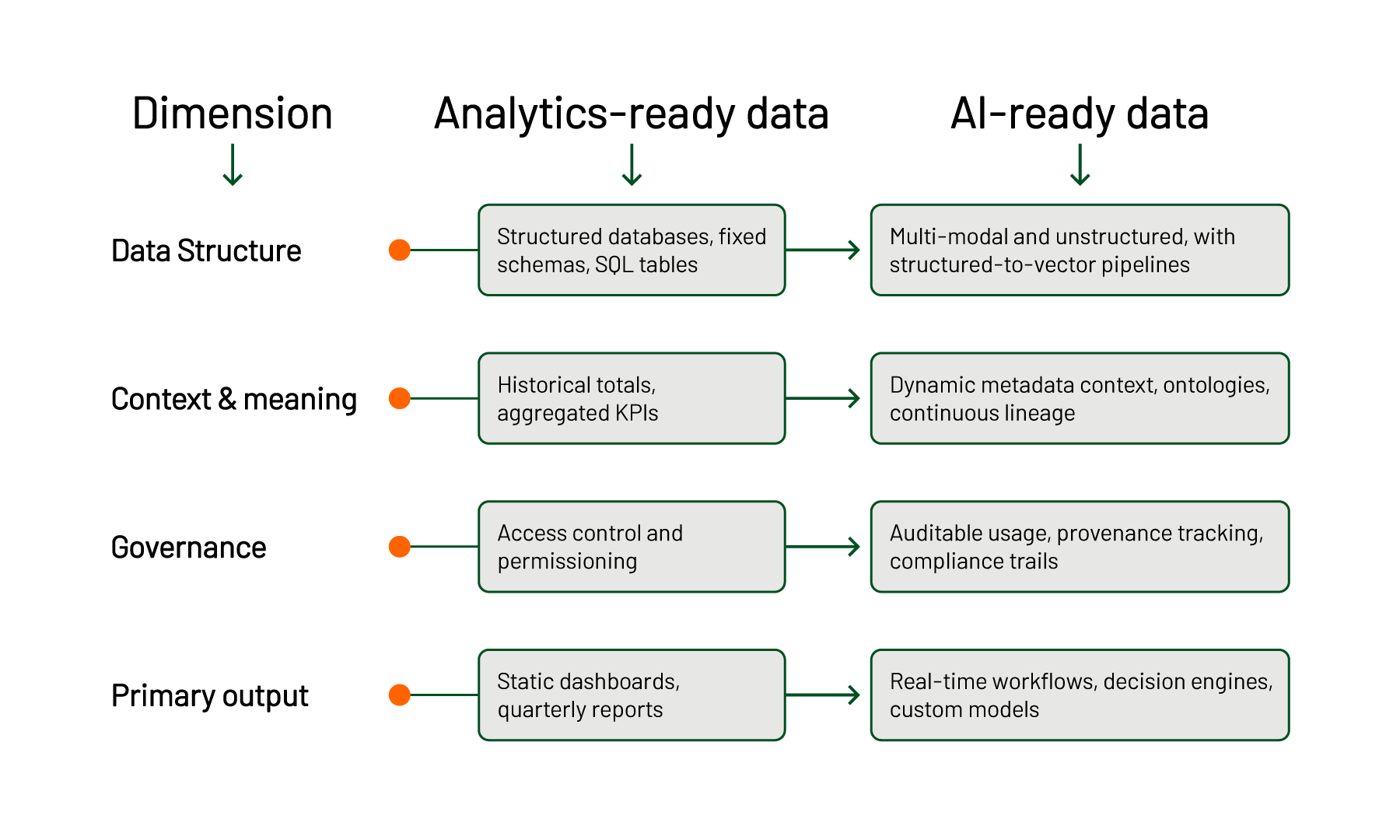
The surveyed organizations invested a decade in business intelligence architectures. That data is structured, backward-looking, and optimized for the quarterly dashboard, ,and it holds up because the people reading it supply what it leaves out: which figures to trust, what changed, and why. However, that data is analytics-ready, not AI-ready.
AI doesn’t have that institutional knowledge, so it takes data at face value. The context employees carry has to be built into the data itself through dynamic metadata, end-to-end lineage, built-in governance, and unstructured data processed at scale.
AI-ready data has to clear four bars: provenance and lineage so origins are known, context and ontology so systems understand what the data means, governance so usage stays controlled, and availability so the data is there the moment a decision depends on it. A quarterly dashboard can limp along without any of these, while an autonomous workflow cannot.
The cost of ignoring this is already landing on the balance sheet. Thirty-seven percent of organizations have paused, scaled back, or abandoned an AI initiative in the past year, and the top reason was data quality or availability, ahead of integration complexity and vendor underperformance. The biggest technical barriers tell the same story, running from too much unstructured data, to biased datasets, to a high volume of irrelevant or redundant data.
The full report breaks down each barrier respondents named.
The AI Confidence Gap
The report's sharpest contrast has nothing to do with technology. It's the distance between how confident leaders feel and what they can actually prove.
On the surface, confidence runs high. Seventy-nine percent of leaders describe their organization as aligned on AI readiness, and 82% feel confident explaining how their AI reaches an output. Underneath, a quarter of leaders admit they struggle to explain or trust those outputs, and 36% cite a lack of internal expertise, the most common challenge in the survey. Only 3% have a documented process for auditing AI.
That's 82% confident against 3% documented. The gap between what leaders believe and what they can prove is the least visible risk in enterprise AI right now, and it doesn't close with new technology. It closes with a process someone has written down. Formalizing AI usage policies and building an audit trail is what turns each initiative into a foundation the next one can build on.
The same pattern runs through the rest of the data. 42% of leaders call themselves only "somewhat confident," following the general logic but unable to always explain a specific decision. Forty-three percent run regular AI training, yet only 27% have a formal AI usage policy. And while 83% see AI readiness as at least a partial competitive advantage and only 4% think they're behind their competitors, just 3% can document how they audit their AI. Regulatory and compliance uncertainty is the second most cited obstacle, at 33%, which is exactly the kind of exposure an undocumented process creates.
It's important for leaders to have confidence in their organization's AI capabilities, but that confidence has to be backed by processes that are governable, auditable, and scalable. An AI audit process doesn't have to be elaborate. The strongest AI governance and compliance frameworks we see in our client work share four habits:
- Trace provenance. Know where every data source behind an AI decision comes from and how it has changed.
- Document usage policies by role. Spell out who can use which systems, for what purpose, and with which data.
- Log decisions and overrides. Keep a record of what the system decided and when a person stepped in.
- Review on a fixed cadence. Audit outputs against those policies on a schedule, not only after something goes wrong.
From Divided Ownership to Shared Accountability
The report's final finding most cleanly separates programs that scale from programs that stall.
Ask who owns AI and the answer splits almost evenly. Forty percent of organizations say IT and data teams, and 38% say executive leadership. That makes sense, because AI lives at the intersection of technical execution and business strategy. Only 7% of organizations convene leadership and technical teams in a cross-functional Center of Excellence. Alignment that has never been tested in a room together is a belief, not an operating model.
Ownership and accountability aren't the same thing.
"Ownership is just one step towards accountability. A team can be responsible for AI decisions without being held to clear business outcomes. The organizations making progress have executive sponsors who set the vision and own the financial goals." — Jason Tabeling, Head of Solutions, Further
The pattern behind the leaders is practical, and it starts with the business problem, not the technology:
- Define the business problem before expanding the budget. In the report, the most common first step among organizations making scalable progress is defining the problem to solve, followed by validating and centralizing the data.
- Pair technical owners with a named C-suite financial sponsor. A sponsor sets the vision and owns the financial goals, so accountability maps across functions instead of living nowhere.
- Establish a cross-functional Center of Excellence to govern usage and audit trails. This is the room where alignment gets tested, not assumed.
The same logic shows up in how organizations buy AI. Thirty-four percent customize existing vendor solutions, 14% build proprietary models in-house, and the most common approach to new AI, at 39%, is optimizing technology already in place. The organizations pulling ahead aren't spending the most. They're the most deliberate about what they point AI at, and why.
Where You Actually Stand
Organizations closing the gap to AI maturity define success early, build data for decisions, document and benchmark their progress, and pair ownership with a named sponsor. If you're sponsoring AI in your organization, four questions will show you which side of the gap you're on:
- Have we defined what success means before we scale the spend?
- Is our data built for the decisions AI will make, or for last quarter's report?
- Could we confidently prove how our AI reached a decision?
- Does every AI initiative have a named executive sponsor who owns the outcome?
The State of Enterprise AI Maturity report has the full data behind each of these findings. To see which stage of the maturity curve you're in and how you compare, contact us to benchmark your organization today.
What is the difference between analytics-ready and AI-ready data? Analytics-ready data is structured, backward-looking data optimized for BI dashboards and reporting, built on fixed schemas and SQL tables. AI-ready data is multi-modal and context-rich, combining dynamic metadata, ontologies, unstructured pipelines, and continuous lineage tracking that AI systems need to reason reliably. Only 5% of organizations believe their data is largely AI-ready.
Why do enterprise AI initiatives stall before they scale? Most stall on foundations, not models. 37% of organizations paused or abandoned an AI initiative in the past year, with data quality or availability the top reason (24%). Undocumented governance and divided ownership compound the problem. Just 3% have a documented AI audit process and only 7% run a cross-functional Center of Excellence.
What role does executive sponsorship play in AI maturity? Executive sponsorship is what turns ownership into accountability. AI decision-making splits almost evenly between IT/data teams (40%) and executive leadership (38%), but progress comes when a named C-suite sponsor sets the vision and owns the financial goals, mapping accountability across functions rather than leaving it unassigned.
What are the core steps to build an auditable AI governance process? Start by inventorying your AI models, agents, and the data behind them, and assign an accountable owner to each. Document intended use, testing, and known limitations, including what each agent can access and what it can do without human approval. Then set a review cadence with logged decisions. Auditability comes from a trusted, repeatable process that you can automate as AI scales across the organization.