AI FinOps for the Agentic Era: How Enterprises Can Regain Control of Cloud Costs
Token prices are falling, yet AI budgets are ballooning. The root cause isn't waste or mismanagement—it's the fundamental shift to autonomous systems, and it requires a new financial discipline that most organizations haven't built yet.
For the last two years, the narrative around enterprise AI has felt reassuring: as models become more efficient, the cost to run them will naturally drop. But across the Fortune 500, a very different reality is setting in. Enterprise leaders who spent last year trying to get AI to work are now staring at their cloud bills, trying to understand why the systems that finally do work are burning through budgets at an unprecedented rate.
When a massive cost overrun hits, the instinct is to assume someone made a mistake – that an engineer left a server running or wrote a highly inefficient query. But the hardest thing to explain to a board right now is that the engineering teams didn’t fail. The financial hemorrhage is actually a symptom of the system doing exactly what we asked it to do.
We keep treating these overruns like a standard procurement problem that requires better oversight. In reality, you can’t negotiate your way out of this with your cloud provider. The costs are baked directly into the engineering, meaning your architecture is now dictating your economics.
The Hidden Cost of Autonomous Agents
When enterprise leaders rolled out generative AI, especially AI coding assistants, the goal was simple: get more output. And initially, it worked. Teams moved faster and generated more code, more content, and more analyses. But organizations quickly slammed into a financial reality they hadn't faced in the traditional software era. In the age of AI, productivity has a steep marginal cost.
In the traditional SaaS model, software is a fixed cost. If an engineer uses a licensed tool to double their daily output, the cost of the software stays exactly the same. The more your team uses the tool, the better your ROI.
Agentic AI flips that economic model entirely. Because you are paying for compute and tokens, every extra line of code, every automated search, and every generated report carries a variable cost. You aren't just paying for access, you are paying per unit of output.
This is exactly why the ROI equation is breaking down for so many early adopters. By early 2026, a clear pattern surfaced. According to reporting from The Information, Uber gave its engineers a powerful AI coding tool and exhausted its entire 2026 AI budget in four months. They eventually had to cap engineers at $1,500 a month to stop the bleeding. Microsoft reportedly scaled back internal licenses for similar tools once the true run-rate came into focus.
These organizations didn't pull back because the tools failed to generate output. They pulled back because they realized that raw, AI-generated output was costing them exponentially more money, and that sheer volume of output was not automatically translating to bottom-line business value. Traditional IT cost controls are built to manage fixed seat licenses. They are completely unequipped to manage variable systems where every burst of productivity actively drives up the invoice.
The Agentic Multiplier: Why Cheaper Tokens Drive Higher Spend
There is a dangerous assumption right now that because token prices are dropping, enterprise AI will naturally get cheaper to operate. Historically, technology economics behave quite differently.
In 1865, the economist William Stanley Jevons noticed that when steam engines became more efficient, Britain actually burned far more coal. Because it was cheaper to use, industry found vastly more applications for it. Tokens are following the exact same macroeconomic logic. Because it’s cheaper to trigger an LLM, we are letting agents run longer and handle significantly more complex reasoning loops. The efficiency isn't saving us money; it's just subsidizing massive behavioral changes in how our software operates.
Autonomy is the primary multiplier here. A standard chatbot answers a user's prompt and stops. An agentic system keeps working—pulling context from databases, calling external tools, evaluating its own output, and sometimes running unattended for hours. A single user instruction easily cascades into dozens or hundreds of billed LLM calls.
The Three Black Holes in Your GenAI Budget
In the SaaS era, software costs sat neatly on a price sheet: seats multiplied by a negotiated annual rate. Today, cost is a direct function of system behavior. The invoice you get at the end of the month is simply a lagging indicator of thousands of micro-architectural decisions that no one is actively monitoring.
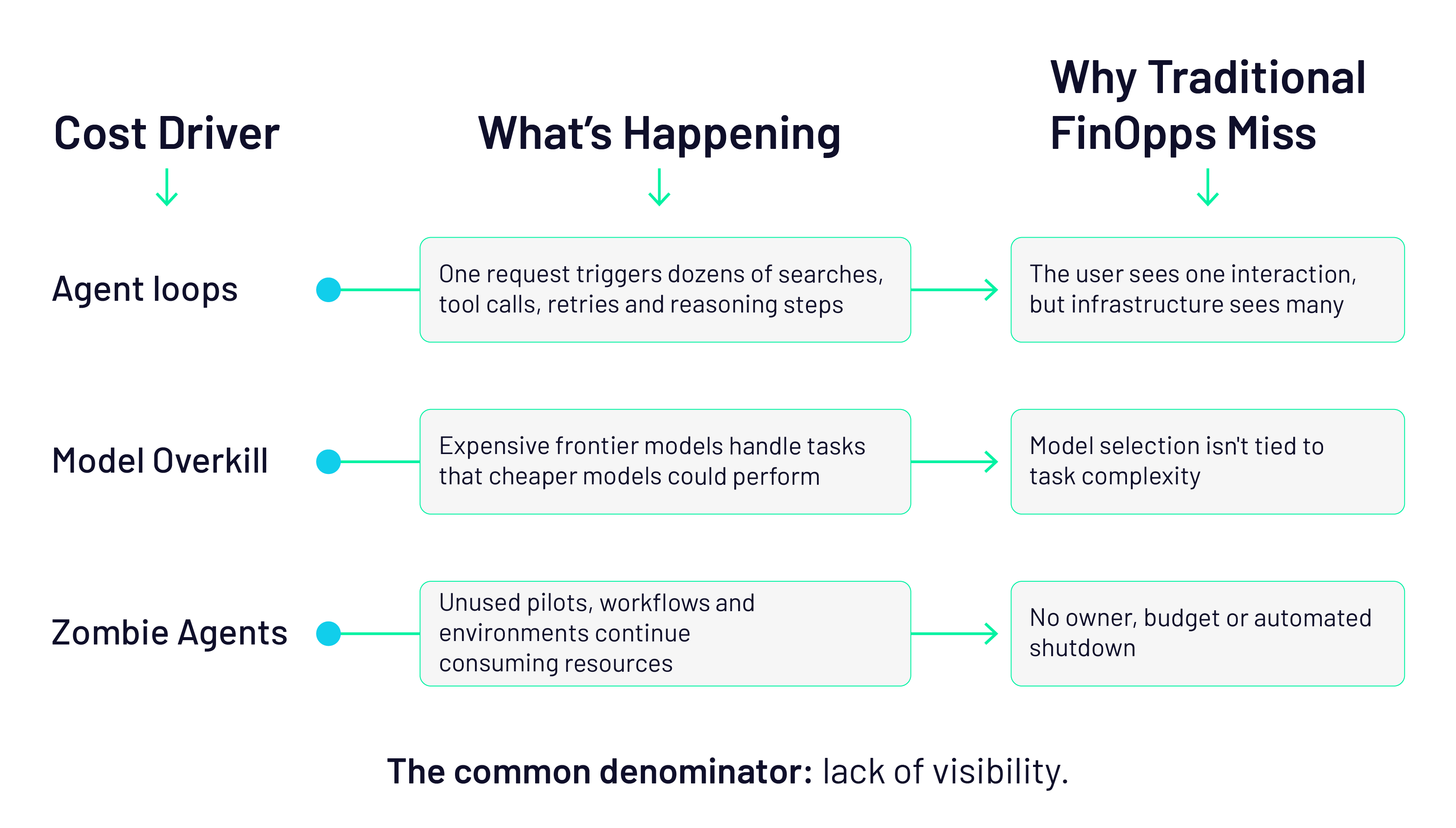
In our work with enterprises, we typically find the budget draining in three specific areas:
Agent Loops: The unseen cascade of searches, tool calls, and retries. You see one request; the system executes forty.
Model Overkill: Defaulting to the most expensive frontier model for ordinary work (for instance, using GPT-4 or Claude Opus to summarize a standard internal email, when a smaller model like Llama 3 8B or Gemini Flash would do the job for 90% less).
Zombie Agents: Pilots and test environments that are stood up, forgotten, and left to run autonomously, billing against the cloud account every night with no clear owner.
Underneath each of these issues is the same fundamental gap: Most organizations cannot yet see their AI the way they see their traditional cloud infrastructure. And you cannot manage what you cannot see.
From FinOps to TokenOps: Building the Discipline
The good news is that the correction relies on a muscle most enterprises already have. We need to take the core principles of FinOps – the practice that successfully brought cloud computing spend under control – and apply them to tokens.
It starts with absolute visibility. Engineering teams need to instrument every LLM call so that spend can be tracked by team, by product feature, and by business outcome. Once you have visibility, optimization pays off quickly. You can cache the context you send repeatedly (which providers bill at a fraction of the standard rate) and implement semantic routing to reserve expensive models only for the complex problems that warrant them.
Ultimately, this allows you to establish ceilings. Every autonomous workflow needs an owner, a hard budget, and an automated circuit breaker, so that spending becomes a strategic choice rather than an end-of-month discovery.
The metric that holds all of this together is a shift away from "cost per token" to "cost per outcome,” whether that outcome is a resolved customer ticket, an approved claim, or a shipped feature. Measured that way, a cheap model that hallucinates half the time is actually wildly expensive, and a premium model that gets it right on the first try is the bargain. This is the translation layer your CFO actually needs to validate the ROI of the technology.
The Leadership Mandate: Four Questions to Ask Your Team
This level of discipline doesn't organize itself from the bottom up. It requires a mandate from leadership. If you are sponsoring AI initiatives right now, asking your team these four questions will tell you exactly where your organization stands:
- Can we currently trace our AI spend to a specific team, use case, and business outcome, or are we just looking at a bulk monthly total?
- Are we measuring the cost of an actual business outcome, or are we still just measuring cost per token?
- Does every active agent and workflow have a designated owner, a budget, and an automated spend ceiling?
- If a specific workflow doubled in cost overnight, how long would it take us to notice, and could we identify the cause?
If those answers don't come easily, your AI consumption is likely already outrunning your financial oversight.
That is the exact gap we close at Further. We tend to get the call when the enterprise promise of AI is clear, but the underlying economics are not. We help leadership teams build the visibility, routing, and discipline required to make AI scalable and durable, ensuring every dollar maps to a result you can defend to your board.
If your team is struggling to answer the four questions above, we would welcome a conversation. Reach out to schedule a session with our strategy team.
Sources: reporting from The Information, Fortune, The Verge, and the Financial Times; Goldman Sachs Research, Decoding the Agentic Economy; Gartner; and provider pricing via CloudZero and Opslyft.